
Our Book Selections of the Month feature timely, curated texts that illuminate truth, deepen critical analysis, awaken memory, challenge erasure, and guide educational transformation toward liberation.
Home / Digital Library References
I’m Professor Jamal Turner, and in this video, we’ll dive into Critical Race Theory and the racial taxonomy behind white supremacy. We’ll trace how these categories were fabricated in colonial pseudoscience and arm ourselves with the tools to dismantle them. Get ready to unravel the myths that have shaped our world.
Adeyemi, K. (2023). Cultural memory and the reclamation of histories: African diaspora and
counter-narratives. Journal of Cultural Reclamation, 8(1), 78–98.
https://doi.org/10.1177/0123456-2023
Ahmed, S., & Sharma, R. (2023). Impact of culturally responsive pedagogy on learning
engagement and academic performance. https://eric.ed.gov/
Akhimie, P. (2019). Shakespeare and Race. Cambridge University Press.
Alexander, M. (2010). The New Jim Crow: Mass Incarceration in the Age of Colorblindness. The
New Press.
Ani, M. (1994). Yurugu: An African-Centered Critique of European Cultural Thought and
Behavior. African World Press.
Aldridge, D.P. (2020). Teachers in the movement: Pedagogy, activism, and freedom.
History of Education Quarterly, 60(1), 1-23. https://doi.org/10.1017/heq.2020.6
Aldridge, D.P. (2015). The ideas and craft of the critical historian of education
Critical approaches to the study of higher education: A practical [DM5] [JT6]
introduction. Johns Hopkins University Press.
Allen, A., Hancock, S. D., Starker-Glass, T., & Lewis, C. W. (2017). Mapping culturally
relevant pedagogy into teacher education programs: A critical framework. Teachers
College Record, 119(1), 1-26. https://doi.org/10.1177/016146811711900107
Anya, U. (2021). Critical race pedagogy for a more effective and inclusive world language
Teaching. Applied Linguistics, 42(6), 1055–1069.
https://doi.org/10.1093/applin/amab068.
Asante, M. K. (1988). Afrocentricity: The Theory of Social Change. Africa World Press.
Banks, J. A. (1998). Multiculturalism’s five dimensions. In M. Tucker (Ed.), Educating
citizens in a multicultural society (22-95). Teachers College Press.
Bell, D. (1988). And we are not saved: The elusive quest for racial justice, Michigan
Law Review, 86(6), 1130–1135. https://doi.org/10.2307/1289158.
Bell, D. (1972). Brown v. Board of Education and the interest-convergence dilemma. Harvard
Law Review, 93(3), 518-533.
Ben-Jochannan, Y. (1993). African Origins of Major Western Religions. Black Classic Press.
Bernal, M. (1987). Black Athena: The Afroasiatic Roots of Classical Civilization. Rutgers
University Press.
Bernasconi, R. (2001). Kant and the Invention of Race. Hackett Publishing.
Boas, F. (1940). Race, Language, and Culture. Free Press.
Bonilla-Silva, E. (2001). Rethinking Racism: Toward a Structural Interpretation. Rowman &
Littlefield
Bonilla-Silva, E. (2017). What we were, what we are, and what we should be: The racial
problem of American sociology. Social Problems, 64(2), 179–187.
https://www.jstor.org/stable/26370899
Brookings Institution. (2018). Educator Bias and Racial Disparities in Schools. Brookings Press.
Brown, K., & Itzigsohn, J. (2019). Du Bois and Double Consciousness. Princeton University
Press.
Budge, E. A. W. (1932). The Queen of Sheba and Her Only Son Menyelek. Oxford University
Press
Budge, E. A. W. (1932). Queens of Ancient Egypt. Dover Publications
Burke, J., Wu, T., & Risk, M. (2019). Structural racism in education: Impacts on student self-
worth and achievement. Academic Press.
Bynum, E. B. (2012). The African Unconscious: Roots of ancient mysticism and modern
psychology. Teacher College Press.
Cann, R. L., Stoneking, M., & Wilson, A. C. (1987). Mitochondrial DNA and Human Evolution.
Nature.
Carey, P. W. (2018). Sin, repentance, and confession in nineteenth-century American Protestant
polemics. Oxford University Press.
Chapman, T. K. & Bhopal, K. (2019). The perils of integration: Exploring the experiences of
Black and Black Caribbean students in predominately white secondary
schools, Ethnic and Racial Studies, 42(7), 1110-1129.
DOI: 10.1080/01419870.2018.1478110
Chesnutt, C. (1899). The Conjure Woman. Houghton Mifflin.
Chesnutt, C. (1901). The Marrow of Tradition. Houghton Mifflin
Copur-Gencturk, Y., Thacker, I., & Cimpian, J. R. (2023). Teachers’ race and gender biases
and the moderating effects of their beliefs and dispositions. International Journal of
STEM Education, 10(31). https://doi.org/10.1186/s40594-023-00420-z
Coates, T.-N. (2014). The Case for Reparations. The Atlantic
Crenshaw, K. (2019). Seeing race Again: Countering colorblindness across the disciplines.
University of California Press.
Crenshaw, K. W. (1988). Race, reform, and retrenchment: Transformation and legitimation
an anti-discrimination law. Harvard Law Review, 101(7), 1331-1387.
Crenshaw, K. (1995). Critical Race Theory: The Key Writings That Formed the Movement. The
New Press.
D’Andrea, M., & Daniels, J. (2020). Institutional racism and the need for critical dialogue
in university settings. Education Policy Review, 35(1), 45-60.
DeCuir-Gunby, J. T., & Schutz, P. A. (2024). The evolution of race-focused and race-
reimaged approaches in educational psychology: Future directions for the
field. Educational Psychology Review, 36, Article
30.https://doi.org/10.1007/s10648-024-09873-2
Delgado, R. (1989). Storytelling for oppositionists and others: A plea for narrative
storytelling. Michigan Law Review, (8)7https://ssrn.com/abstract=1577362.
Delgado, R., & Stefancic, J. (2017). Critical race theory: An Introduction (3rd ed.). New York
University Press.
.Diamond, J., & Gomez, A. (2020). The Socialization of White Supremacy in Education.
Routledge.
Diamond, J. B., & Gomez, L. M. (2023). Disrupting white supremacy and anti-Black racism in
educational organizations. Education Researcher, 0(0).
https://doi.org/10.3102/0013189X231161054
Diop, C. A. (1981). The African Origin of Civilization: Myth or Reality. Lawrence Hill
Books.
Diop, C. A. (1987). Precolonial African Warfare. Chicago Review Press.
Diop, C. A. (1981). Civilization or Barbarism: Authentic Anthropology. Lawrence Hill
Books.
Dixson, A. D., & Rousseau Anderson, C. (2018). Where are we? Critical race theory in
education 20 years later. Peabody Journal of Education, 93(1), 121–131
https://doi.org/10.1080/0161956X.2017.1403194.
Du Bois, W.E.B. (1903). The Souls of Black folk” by A. C. McClurg & Co., Chicago.
Du Bois, W. E. B. (1899). The Philadelphia Negro: A social study. University of Pennsylvania
Press.
Duchesneau, F. (2023). Blumenbach on the varieties of the human species. Humankind and
Humanity in the Philosophy of the Enlightenment, 209.
https://api.pageplace.de/preview/DT0400.9781350142947_A47080903/preview-
9781350142947_A47080903.pdf
Duzgun, E. (2022). Radicalising global IR: Modernity, capitalism, and the question of
Eurocentrism. The Chinese Journal of International Politics, 15(3), 313–333.
https://doi.org/10.1093/cjip/poac012
Douglass, F. (1845). Narrative of the Life of Frederick Douglass, an American Slave. Anti-
Slavery Office.
Evans, L., & Martinez, V. (2020). Racial constructs and their consequences: Unraveling the
social construction of race. Journal of Ethnic Studies, 38(2), 145–167.
https://doi.org/10.1080/12345678.2020.1234567
Eze, E. C. (1997). Race and the Enlightenment: A Reader. Blackwell Publishing.
Eze, E. C. (1997). The Color of Reason: The Idea of Race in Kant’s Anthropology. University of
Minnesota Press
Fanon, F. (1952). Black Skin, White Masks. Grove Press.
Freire, P. (1970). Pedagogy of the Oppressed. Bloomsbury Academic.
Escayg, K. A. (2019). “Who’s got the power?” A critical examination of the anti-bias
curriculum. International Journal of Early Childhood Education Policy, 6(13), 1-15.
https://doi.org/10.1186/s40723-019-0062-9
Ford, D. Y. (2017). Culturally responsive classrooms: Addressing the
achievement gap. Research Gate. EJ874024.pdf.
Gates Jr., H. L. (2014). Phillis Wheatley on Trial. Harvard University Press.
Gates, H. L. Jr. (1988). The Signifying Monkey: A Theory of African American Literary
Criticism. Oxford University Press.
Gates, H. L. Jr. (1993). The Black Atlantic: Modernity and Double Consciousness. Harvard
University Press.
Gates, H. L., Jr., & McKay, N. Y. (Eds.). (1996). The Norton anthology of African American
literature. W. W. Norton & Company.
Gates, H. L., Jr. (Ed.). (2025). The Norton anthology of African American literature (4th
ed.). W. W. Norton & Company.
García, J., & O’Donnell, J. (2022). Transformative ethnic studies in schools:
Curriculum, pedagogy, and research. Teachers College Press
Garnet, H. H. (1843). An Address to the Slaves of the United States of America. National Negro
Convention.
Gay, G. (2018). Culturally responsive teaching: Theory, research, and practice (3rd
Ed.). Teachers College Press.
Gay, G. (2022). Using inquiry-based learning to create a culturally responsive
classroom. ELT Weekly. http://eltweekly.com/2022/05/using-inquiry-based-
Geary, D. C., & Xu, K. M. (2022). Evolution of self-awareness and the cultural
emergence of academic and non-academic self-concepts. Educational
Psychology Review, 34(4) 2323-2349DOI: 10.1007/s10648-022-09669-2
Gildersleeve, R. E., Croom, N. N., & Vasquez, P. L. (2011). “Am I going crazy?!”: Critical
race analysis of doctoral education. Equity & Excellence in Education, 44(1), 93
https://doi.org/10.1080/10665684.2011.539472
Gildersleeve, R. E. (2022). Race and racism in higher education. About Campus, 27(4), 3-3.
https://doi.org/10.1177/10864822221134355.
Givens, J. R. (2021). Fugitive pedagogy: Carter G. Woodson and the art of Black teaching.
Harvard University Press. https://doi.org/10.4159/9780674259102.
Gomez, F. (2021). Tracing Our Shared Genetic Heritage: The Role of Mitochondrial Eve.
Journal of Genetic Anthropology
Gómez, R. F., Bennett, E., & Cammarota, J. (2023). The battle for curriculum: Arrested
semantics and reconciling racism with critical race theory and ethnic studies. Race
Ethnicity and Education, 1–18.
https://doi.org/10.1080/13613324.2023.2239726
Gomez, R., & White, S. (2021). Anti-racist pedagogy in higher education: A critical literature
review. Journal of Critical Education Studies, 29(4), 37–59.
https://doi.org/10.1080/987654321.2021.987654
Gooding, W.R. (2020). W.E.B. Du Bois, The Stanford Encyclopedia of
Philosophy. https://plato.stanford edu/archives/spr2020/entries/dubois.
Gordon, W. R., Smith, J. A., & Lee, K. T. (2021). Developing the curriculum: Improved
outcomes through systems approach (9th ed.). The Pearson Educational
Leadership Series.
Graves, J. L. Jr. (2014). The Emperor’s New Clothes: Biological Theories of Race. Rutgers
University Press.
Groves, P. (2020). Critical race theory. Oxford Research Encyclopedia of Educational
https://oxfordre.com/education/view/10.1093/acrefore/9780190264093.001.
0001/acrefore-9780190264093-e-1.
Grynaviski, J., & Munger, M. (2017). Reconstructing Racism: Transforming Racial Hierarchy
from “Necessary Evil” into “Positive Good.” Social Philosophy and Policy
Gutiérrez, G., & Müller, G. L. (2015). On the side of the poor: The theology of liberation.
Maryknoll, NY: Orbis Press.
Hammond, Z. (2023). Culturally responsive teaching and the brain: Promoting authentic
engagement and rigor among culturally and linguistically diverse students. Corwin.
Harmon, D. A. (2012). Culturally responsive teaching through a historical lens: Will history
repeat itself? Interdisciplinary Journal of Teaching and Learning, 2(1), 12–22.
https://www.bing.com/search?q=harmon%2C+d.+a.+(2012).
Harper, S. R. (2023). Race without racism: How higher education researchers minimize racist
institutional norms. Journal of Higher Education, 94(2), 123–145.
Harris, C. I. (1993). Whiteness as property. Harvard Law Review, 106(8), 1707-1791
Harrison, F. V. (1991). Decolonizing Anthropology. American Anthropological Association.
Hayvon, J. C. (2024). Action against inequalities: A synthesis of social justice & equity,
diversity and inclusion frameworks. International Journal for Equity in Health, 23(1),
DOI for the article is 10.1186/s12939-024-02141-3.
Heidegger, M. (1962). Being and Time (J. Macquarrie & E. Robinson, Trans.). Harper & Row.
Hilliard, A. G. (2001). The Reawakening of African Consciousness. Third World Press.
Hilliard, A. G. (2001). African Power Structures. Third World Press.
Holt, T. C. (2000). The Problem of Race in the 21st Century. Harvard University Press.
Horne, G. (2018). Bacon’s Rebellion and Race. Verso Books.
Horne, G. (2014). The Counter-Revolution of 1776: Slave Resistance and the Origins of the
United States of America. New York University Press.
Hu, X., & Hancock, R. (2019). Racial Bias in American Schools. Harvard Education Press.
Huggins, N. I. (1971). Harlem Renaissance. Oxford University Press.
Hunter, T. (2023). Practicing culturally relevant pedagogy: A literature review of classroom
implementation. Oxford University Press.
https://doi.org/10.3390/educsci10050124.
Hunwick, J. O. (1999). Timbuktu and the Songhay Empire: Al-Sa’di’s Ta’rikh Al-Sudan Down to
1613 and Other Contemporary Documents. Brill Academic Publishers.
Hurston, Z. N. (1935). Mules and Men. J.B. Lippincott.
Hurston, Z. N. (1937). Their Eyes Were Watching God. J.B. Lippincott.
Husserl, E. (1962). The crisis of European sciences and transcendental phenomenology.
Northwestern University Press.
Jablonski, N. G. (2012). Living Color: The Biological and Social Meaning of Skin Color.
University of California Press.
Jackson, J. G. (1970). Introduction to African Civilization. Citadel Press.
Jackson, G. L. (1970). Blood is My Eye. University Press
Jacobs, H. (1831). Incidents in the life of a slave girl. https://www.gutenberg.org/ebooks/1103
James, G. G. M. (1954). Stolen Legacy: Greek Philosophy is Stolen Egyptian Philosophy.
EWorld Publishing
Jefferson, T. (1785). Notes on the State of Virginia. J.W. Randolph.
Kambon, K. (2019). The African Unconscious. Routledge
Karp, J. (2024). Slavery, abolition, emancipation, and freedom. Houghton Library.
https://curiosity.lib.harvard.edu/slavery-abolition-emancipation-and-
freedom/feature/civil-war-1861-1865
Karp, J. (2011). Jim Crow and the American Education System. Cambridge University Press.
Kartsonaki, A. (2024). The strategic use of legitimizing norms in unilateral declarations of
independence. Global Studies Quarterly, 4(2). DOI: 10.1093/isagsq/ksae042.
Keay, K. (2022). White Lies Matter: The Evolution, Persistence, and Impact of Scientific Racism.
Western Washington University Honors Projects.
Kendi, I. X. (2020). Deconstructing Black-White Binary Thinking. One World Publications.
Kendi, I. X. (2016). Stamped from the Beginning: The Definitive History of Racist Ideas in
America. One World.
King, J. L. (2017). Education research in the Black liberation tradition: Return what you learned
to the people. Journal of Negro Education, 86(2), 95-114.
https://eric.ed.gov/?id=EJ1215755
Koppelman, K. L. (2020). Understanding human differences:Multicultural education for a
diverse America (6th Ed.). Pearson.
Ladson-Billings, G., & Tate, W. F. (1995). Toward a critical race theory of education. Teachers
College Record, 97(1), 47-68. https://doi.org/10.1177/016146819509700104
Ladson-Billings, G. (2021). Culturally relevant pedagogy: Celebrating 25 years of transforming
education. American Educational Research Journal, 57(1), 163-184.
Ladson-Billings, G. (1995). Toward a theory of culturally relevant pedagogy. American
Educational Research Journal, 32(3), 465-491.
Ladson-Billings, G. (2021). The Dreamkeepers: Successful teachers of Black
children (2nd ed.). Jossey-Bass.
Ladson-Billings, G. (2021). Three decades of culturally relevant, responsive, and sustaining
pedagogy: What lies ahead? The Educational Forum, 85(4), 351
354.https://doi.org/10.1080/00131725.2021.1957632
Lamsal, H. L. (2024). Critical pedagogy in addressing social inequality and promoting social
justice in education. Advances, 5(3), 77-83. DOI: 10.11648/j.advances.20240503.12
Lawrence, S., & Hylton, K. (2022). Critical race theory, methodology, and semiotics: The
analytical utility of a “race” conscious approach for visual qualitative
research. Cultural Studies ↔ Critical Methodologies, 22(3), 255–265.
https://doi.org/10.1177/15327086221081829
Lazaridou, F., & Fernando, S. (2022). Deconstructing institutional racism and the social
construction of whiteness: A strategy for professional competence training in culture and
migration mental health. Transcultural Psychiatry, 59(2), 175–
187.https://doi.org/10.1177/13634615221087101.
Ledesma, M. C., & Calderón, D. (2015). Critical race theory in education: A review of the past
literature and a look to the future. Qualitative Inquiry, 21(3), 206–222.
https://doi.org/10.1177/1077800414557825.
Lee, C. N. (2022). Beyond the four frames of colorblind ideology: Theorizing the impact of
colorblind racism on Black millennials’ racial views. Phylon, 59(1), 3–24.
https://www.jstor.org/stable/27150912.
Leonardo, Z. (2009). Race, Whiteness, and Education. Routledge.
Linebaugh, P., & Rediker, M. (2000). The Many-Headed Hydra: Sailors, Slaves, Commoners,
and the Hidden History of the Revolutionary Atlantic. Beacon Press.
Li, H., & Okafor, C. (2022). Revisiting historical narratives: Deconstructing false constructs in
world history. History and Memory, 34(3), 191–210. https://doi.org/10.1093/hm/34.3.191
Lin, J. C. P. (2023). Exposing the chameleon-like nature of racism: A multidisciplinary look at
critical race theory in higher education. Higher Education 85(1), 1085–1100.
https://doi.org/10.1007/s10734-022-00879-9.
Lopes, I. (2018). African Contributions to Global Medicine. Oxford University Press
Lynch, W. (1712). The Willie Lynch letter and the making of a slave. Long Island City, NY:
African Tree Press. https://archive.org/details/willielynchlette0000lyn.c
Marks, J. (2017). Human Biodiversity: Genes, Race, and History. Routledge.
Matsuda, M. J., Lawrence, C. R., Delgado, R., & Crenshaw, K. W. (1993). Words that
wound: Critical race theory, Assaultive speech, and the First amendment.
Westview Press.
Mba, C (2018). Philosophy and the Rise of ultra-nationalism in contemporary
Euro-American politics, Afo-ecology, The Journal of Pan-African
Studies .11(8) HTTP: www.japanafrican.org/docs/- Mba-final.pdf.
McCarthy, T. (2018). Critical Philosophy of Race: Kant, Hegel, and Du Bois. University of
Minnesota Press
McDougal, S. (2014). Africana studies’ epistemic identity: An analysis of theory and
epistemology. Discipline. Journal of Black Studies, 18(2), 236–250.
http://www.jstor.org/stable/43525547.
Meer, N. (2019). W. E. B. Du Bois, double consciousness, and the ‘spirit’ of recognition. The
Sociological Review, 67(1), 47-62. https://doi.org/10.1177/0038026118765370.
Merleau-Ponty, M. (1945). Phenomenology of perception. Éditions Gallimard
Miller, J. C. (2012). The Problem of Slavery as History. Yale University Press.
Mills, C. (1997). Racism and Philosophy. Cornell University Press.
Mills, C. (2017). Deconstructing Racism in White Consciousness. Oxford University Press.
Mills, C. W. (1997). The racial contract. Cornell University Press.
Morning, A. (2008). Everyone knows it’s a social construct: Contemporary science and the
nature of race. Sociological Theory, 26(3), 232-257
https://doi.org/10.1080/00380237.2007.10571319
Nardo, A. (2021). Exploring a Vygotskian theory of education and its evolutionary foundations.
Educational Theory, 71(3), 331- 349. https://doi.org/10.1111/edth.12345.
Nasar, J. (2018). W.E.B. Du Bois, double consciousness, and the spirit of recognition. The
Sociological Review, 66(1), 1-43. https://doi.org/10.1177/0038026118765370.
Nasar, S. (2018). African American Cultural History and White Racist Judgments. Cambridge
University Press.
Nasar, S. (2021). Recognition and Race. Harvard University Press.
Nasir, T. (2024). Reframing the narrative: Challenging Eurocentrism in modern world economic
historiography. Intellectual Discourse, 32(2), Article 2182.
https://doi.org/10.31436/id.v32i2.2182
Niane, D. T. (1965). Sundiata: An Epic of Old Mali. Pearson Education.
Noguera, P. (2018). Rethinking Black History in Education. Harvard Education Press.
Norris, K. (2022). The theological origins of white supremacy: In witnessing whiteness. Oxford
Academic Press. https://doi.org/10.1093/oso/9780190055813.003.0003.
Nunn, N. (2008). The Long-Term Effects of Africa’s Slave Trade. Journal of Economic
Perspectives.
Oakland Literacy Coalition. (2023). Our Impact. https://oaklandliteracycoalition.org/our-
work/our-impact/
Office of the High Commissioner for Human Rights. (2019). Annual report 2019: Human rights-
based actions bring tangible results. Retrieved
https://www.ohchr.org/en/stories/2020/06/annual-report-2019-human-rights-based-
Omi, M., & Winant, H. (2014). Racial Formation in the United States. Routledge.
Osei, A. (2023). Decolonizing knowledge: Reclaiming African contributions to global
intellectual history. African Studies Review, 66(1), 22–45.
https://doi.org/10.1017/ASR.2023.003
Paris, D., & Alim, H. S. (2023). Culturally sustaining pedagogies: Teaching and learning for
justice in a changing world. World. Teachers College Press.
PBS Resource Bank (2005). David Walker’s Revolutionary Writings.
PBS Resource Bank (2005). Henry Highland Garnet’s Call for Slave Revolt.
PBS Resource Bank (2005). Maria Stewart’s Contributions to Abolition.
PBS Stewart, M. (1831). Political and Religious Lectures. Garrison and Knapp.
PBS Walker, D. (1829). Appeal to the Colored Citizens of the World. John Ball Printing Office.
Ramdeholl, D., & Jones, J. (2023). Confronting institutionalized racism in higher education:
Counternarratives for racial justice. New York, NY: Routledge.
Rentzi, A. (2023). Social justice in education: Creating an inclusive culture at schools through
critical multicultural theory. European Journal of Education and Pedagogy, 5(1), 1-
15.https://ej-edu.org/index.php/ejedu/article/view/802 [3](http.
Rivera, M., & Johnson, K. (2020). Intersectionality in curriculum: Decolonizing Eurocentric
histories. Curriculum Inquiry, 50(1), 45–64.
https://doi.org/10.1080/14678688.2020.1765432
Rodney, W. (1972). How Europe Underdeveloped Africa. Howard University Press.
Roediger, D. (1998). The Wages of Whiteness: Race and the Making of the American Working
Class. Verso Books.
Roediger, D. R. (1998). Black on White: Black writers on what it means to be White. Schocken
Books.
Rosenberg, J. (2019). Epistemology: A Contemporary Introduction. Routledge
Sandals, D. (2023). Ain’t no achievement gap: Anti-literacy laws and the literacy divide. Journal
of Black Studies, 27(7), 172-186. https://doi.org/10.1007/s12111-023-09678-9
Sandals, M. (2023). The Decline of Literacy Among Enslaved Black People. Oxford University
Press.
Singh, R., & Brown, T. (2021). Challenging dominant narratives: A comparative analysis of
colonial and postcolonial epistemologies. Postcolonial Studies Quarterly, 17(2), 134
156. https://doi.org/10.1080/14608944.2021.1589476
Skibba, R. (2019, May 20). The disturbing resilience of scientific racism: How racist biases
continue to maintain a foothold in research today. Scientific American.
Scott-Jones, G. (2020). The traumatic impact of structural racism on Blacks.
Delaware Journal of Public Health, 6(5), 80-82.
https://doi.org/10.32481/djph.2020.11.019
Sleeter, C. E., & Carmona, J. F. (2021). Un-standardizing curriculum: Multicultural teaching in
the standards-based classroom. Teachers College Record, 123(2), 1-25.
Smedley, A. (1999). Race in North America: Origin and Evolution of Worldview.
Westview Press
Smith, W. A., & Harper, S. R. (2021). Racial battle fatigue in higher education: Exposing the
myth of post-racial America. Rowman & Littlefield.
Smith, S. (2020). Windows into the history and philosophy of education. Kendall Hunt
Publishing.
Solomos, J., & Back, L. (2020). Theories of race and racism: A Reader (2nd ed.).
Routledge. https://doi.org/10.4324/9781003060802.
Solórzano, D. G., & Yosso, T. J. (2023). Critical race methodology: Counter-storytelling as an
analytical framework for educational research. Routledge
Solórzano, D. G., & Yosso, T. J. (2002). Critical race methodology: Counter-storytelling as an
analytical framework for education research. Qualitative Inquiry, 12(1), 23-44.
https://doi.org/10.1177/107780040200800103
Subotnik, D. (2017). What is wrong with critical race theory: Reopening the case for middle-
class values. Cornell Journal of Law and Public Policy 7(3).
https://scholarship.law.cornell.edu/cjlpp/vol7/iss3/1/.
Suddick, M., & Parker, J. (2020). The work of hermeneutic phenomenology. International
Journal of Qualitative Methods, 19, 1-13. https://doi.org/10.1177/1609406920947600.
Taylor, J. (1998). W.E.B. Du Bois’s challenge to scientific racism. Journal of Black Studies,
29(4), 449-466. Sage Publications, Inc.
https://doi.org/10.1177/002193479802900405
Templeton, A. R. (1998). Human Races: A Genetic Reality or Social Myth? American
Anthropologist.
Thomas, D. S. P., & Quinlan, K. M. (2023). Reimagining curricula: Effects of cultural
insensitivity of curricula on racially minoritized students’ engagement. Studies
in Higher Education, 48(2), 283–298.
https://doi.org/10.1080/03075079.2022.2134332
Tichavakunda, A. A. (2023). Critical race theory in higher education: Where we are and
where we need to go. In L. W. Perna (Ed.), Higher education: Handbook of
theory and research (39). Springer International Publishing.
Tolay, J. (2021). Inadvertent reproduction of Eurocentrism in IR: The politics of critiquing
Eurocentrism. Review of International Studies, 47(Special Issue 5), 692–713.
https://doi.org/10.1017/S0260210521000176
Tsosie, R. (2022). Institutional racism and the ethics of inclusion: What does justice require to
transform institutions of higher education? In J. McGregor & M. C. Navin (Eds.),
Education, inclusion, and justice (11). Springer. https://doi.org/10.1007/978-3-031-
04013-9.
Turner, J.-J. (2021). Ripples of time: Memoir of a former Black Panther. Hotep Book Publishing.
Ugur, H., Constantinescu, P.M., & Stevens, M.J. (2015). Self-awareness and personal
growth: Theory and application of Bloom’s taxonomy. Eurasian Journal of
Educational Research, 60, 89-110. Doi: 10.14689/ejer.2015.60.6.
Upasona, R. (2021). Situating Race in The Tempest. Cambridge University Press.
van Lamoen, P. M., Meeuwisse, M., Hiemstra, A. M. F., Arends, L. R., & Severiens, S. E.
(2024). Supporting students’ transition to higher education: the effects of a pre-academic
program on sense of belonging, academic self-efficacy, and academic
achievement. European Journal of Higher Education, 1–22.
https://doi.org/10.1080/21568235.2024.2331122
Van Manen, M. (1990). Researching lived experience: Human science for an action sensitive
pedagogy. SUNY Press.
Van Sertima, I. (1976). They Came Before Columbus. Random House. Press.
. Random House.
Van Sertima, I. (2009). The Lost Sciences of Africa: An Overview. Transaction Publishers
Wah, Y. L., & Nasri, N. B. M. (2019). A systematic review: The effect of culturally responsive
pedagogy on student learning and achievement. International Journal of Academic
Research in Business and Social Sciences, 9(5). https://doi.org/10.6007/IJARBSS/v9-
i5/5907
Wallace, B. (2022). Black critical theory in action: Analyzing the specificity of (anti)Blackness.
Black Studies, 26(4), 375-392. https://doi.org/10.1007/s12111-022-09594-2
Walker, R. (1999). Classical splendour: Roots of Black history. Bogle‐l’Ouverture Press Ltd.
Walker, R. (2011). When we ruled: The ancient and medieval history of Black civilisations. Black
Classic Press.
Walker, R. (2014a). Blacks and religion (Vol. 1): What did Africa contribute to the origin of
religion? The equinox and the real story behind Easter & understanding the Book of the
Dead. CreateSpace Independent Publishing Platform.
Walker, R. (2014b). The rise and fall of Black Wall Street and the seven key empowerment
principles. CreateSpace Independent Publishing Platform.
Walker, R. (2025). African ancient origins: Stories of people & civilization. Flame Tree
Collections.
Warikoo, N., Sinclair, S., Fei, J., & Jacoby-Senghor, D. (2016). Examining racial bias in
education: A new approach. Educational Researcher, 45(9), 508
514https://doi.org/10.3102/0013189X16683408
Warren, C. A. (2022). Urban preparation: Young Black men moving from chicago’s south side
to success in higher education. Harvard Education Press.
Weir, K. (2016). Inequality at school: What is behind the racial disparity in our
educational system? American Psychological Association.47(10), 42.
https://www.apa.org/monitor/2016/11/cover-inequality-school
Williams, E. R. (2018). First things first: Privilege, power, and pedagogy: The
antecedent of assessment (equity response). Urbana, IL: University of Illinois and
Indiana University, National Institute for learning Outcomes Assessment (NILOA).
Williams, C. (1976). The Destruction of Black Civilization: Great Issues of a Race from 4500
B.C. to 2000 A.D. Third World Press.
Williams, E. (1994). Capitalism and Slavery. University of North Carolina Press.
Woodson, C.G. (1933). The miseducation of the negro
http://www.jpanafrican.org/ebooks/3.4eBookThe%20Mis Education.pdf
Woodson, C. G. (2021). The miseducation of the negro. History of Education Quarterly,
55(3), 273-293. https://doi.org/10.1111/hoeq.12122.
Woodson, C. G., & Snyder, J. A. (2015). Progressive education in Black and white:
Rereading Carter G. Woodson’s The miseducation of the Negro. History of
Education Quarterly, 55(3), 273–293. https://doi.org/10.1111/hoeq.12122
Yawp, A. (1860). Harriet Jacobs on Rape and Slavery.
Yosso, T. J., & Solórzano, D. G. (2006). Critical race counter stories along the
chicana Educational Pipeline. Routledge.
Zack, N. (1997). Ideas of Race in the History of Modern Philosophy. Blackwell Publishing.
Adeate, T., & Sewchurran, A. (2023). African epistemologies and the decolonial curriculum.
Acta Academica, 55(1).
Anderson, R. (n.d.). Afrofuturism and world order. Ohio State University Press.
Ani, M. (1994). Yurugu: An African-centered critique of European cultural thought and
behavior. Africa World Press.
Asante, M. K. (1998). The Afrocentric idea (Rev. ed.). Temple University Press.
Bynum, E. B. (2012). The African unconscious: Roots of ancient mysticism and modern
psychology. Teachers College Press.
Butler, O. E. (1979). Kindred. Beacon Press.
Butler, O. E. (1995). Bloodchild and other stories. Seven Stories Press.
Dei, G. J. S. (2012). Indigenous philosophies and critical education: A reader. Peter Lang.
Delany, M. R. (2000). Blake; or, The huts of America (F. S. Rollins, Ed.). Beacon Press.
(Original work published 1859–1862)
Dery, M. (1994). Black to the future: Interviews with Samuel R. Delany, Greg Tate, and Tricia
Rose. In M. Dery (Ed.), Flame wars: The discourse of cyberculture (pp. 179–222). Duke
University Press.
Diop, C. A. (1974). The African origin of civilization: Myth or reality (M. Cook, Trans.).
Lawrence Hill Books.
Du Bois, W. E. B. (1903). The souls of Black folk. A. C. McClurg & Co.
Du Bois, W. E. B. (1920). The comet. In Darkwater: Voices from within the veil (pp. 179–190).
Harcourt, Brace and Howe.
Hopkins, P. E. (2012). Of one blood; or, The hidden self. Washington Square Press. (Original
work published 1903)
Lavender III, I., & Yaszek, L. (Eds.). (2020). Literary Afrofuturism in the twenty-first century.
Ohio State University Press.
Shockley, K. M., Bunche Smith, T., & Durden, T. (2021). African-centered education practice
guide: Transformative, culturally responsive practices for Black children’s excellence.
Equity Research Action Coalition.
Strait, K. M., & Conwill, K. H. (Eds.). (2023). Afrofuturism: A history of Black futures.
Smithsonian Books. (Published in association with the National Museum of African
American History and Culture)
Walker, R. (2006). When we ruled: The ancient and medieval history of Black civilizations.
Every Generation Media.
Wheatley, P. (1773). On imagination. In Poems on various subjects, religious and moral (pp.
95–98). A. Bell, Bookseller.
Womack, Y. L. (2013). Afrofuturism: The world of Black sci-fi and fantasy culture. Lawrence
Hill Books.
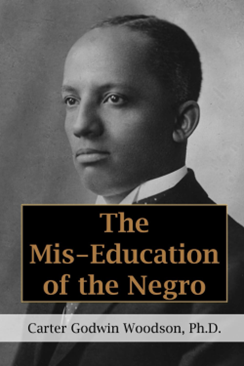
Woodson’s 1933 classic is a searing indictment of the American education system’s failure to empower African Americans. He argues that Black students are not educated but indoctrinated—trained to accept inferiority and to seek validation within systems that exclude them. Through sharp critique and historical analysis, Woodson exposes how Eurocentric curricula erase African heritage and condition Black learners to serve rather than lead. His call for self-education, cultural reclamation, and Afrocentric pedagogy remains urgent today, especially in the context of curriculum reform and racial justice in schools. The book is both a blueprint for liberation and a mirror reflecting the psychological scars of systemic miseducation.
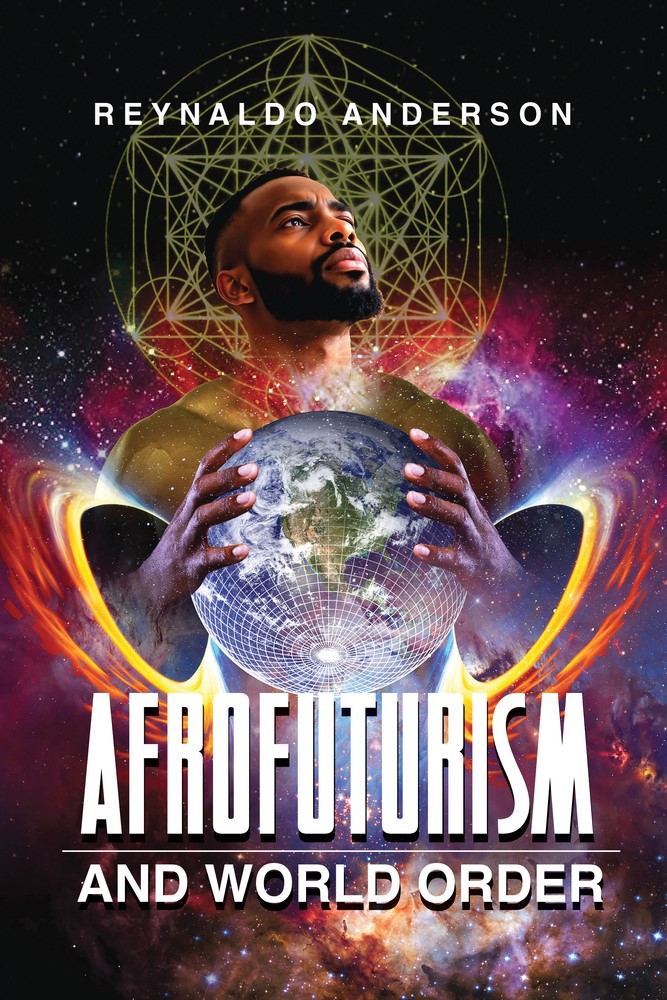
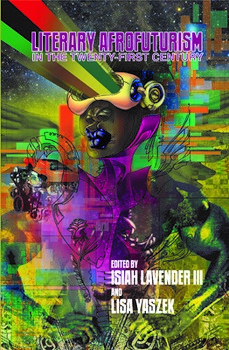
In Literary Afrofuturism in the Twenty-First Century, eminent contributors pay tribute to Afrofuturism as a powerful and evolving aesthetic practice that communicates the experience of science, technology, and race across centuries, continents, and cultures. While Ryan Coogler and Janelle Monae may have helped bring the genre into contemporary pop consciousness, it in fact extends back to the writing of eighteenth-century poet Phyllis Wheatley and has continued in the work of Samuel R. Delany, Octavia E. Butler, N. K. Jemisin, and many others. In examining this heritage, contributors in this volume question generic boundaries, recover lost artists and introduce new ones, and explore how the meteoric rise of a new, pan-African speculative literary tradition may or may not connect with Afrofuturism.

ATEP 2025: A Transformational Education Project
Deconstructing Racism Through Transformational Education
+1 (704) 400-0332
kngturner@netscape.net
Charlotte, North Carolina